Clearing a piece of land can make a huge difference. But if small trees and brush start coming back a few weeks or months later, you may wonder what went wrong.
The answer is often below the surface. Some trees can send new shoots from old roots or stumps after you cut down the visible growth. Simply mowing or cutting the new growth may not solve the problem for good.
If you want cleared land to stay clear, you also need to address the roots, stumps, and remaining vegetation.
Why Do Saplings Keep Coming Back After Land Clearing?
Saplings can return because their root systems may still be alive after the above-ground growth is removed. A stump may also have enough stored energy to send up new shoots.
These shoots are sometimes called suckers. They can appear around old stumps or farther away when connected roots send up new growth. Some tree species are much more likely to do this than others.
That is why cutting a sapling at ground level doesn’t always end the problem. The visible stem is gone, but the root system may still be active.
How Can You Remove Saplings So They Do Not Return?
The best method depends on the size of the growth and what remains underground.
For small areas, removing young saplings at the source can help. If there is a stump, removing or grinding it can reduce the source of new growth. Stump grinding removes much of the wood below the surface, making it harder for the remaining root system to keep producing shoots.
Large areas require a different approach. Digging out every root by hand is slow and can disturb the soil. Professional land clearing equipment can handle dense brush, saplings, and woody growth across larger sections of property.
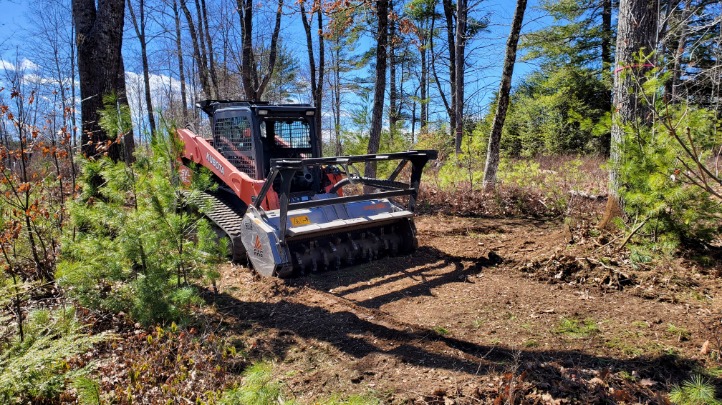
Jay’s Brush Clearing handles the areas that ordinary mowers cannot, including dense undergrowth, saplings, and invasive shrubs. Our forestry mulching equipment cuts, grinds, and mulches vegetation on-site instead of leaving large debris piles.
Can Mowing or Cutting Stop Sapling Regrowth?
Mowing can keep new shoots short, but it may not remove the cause of the regrowth.
When a root system remains alive, repeated cutting can leave the plant with enough underground energy to produce more shoots. Research and tree care sources recommend removing growth close to its origin rather than repeatedly cutting visible shoots several inches above the ground.
For a small number of saplings, regular removal may eventually weaken the root system. On a large property, though, constant mowing can turn into a cycle that never really ends.
That is where proper land clearing can save time and effort.
What Can You Do About Saplings Growing From Old Roots?
Start by figuring out what is producing the new growth. If the sapling connects to an old stump or root system, removing the source gives you better control than simply cutting the new stem.
Stump grinding is one option when old stumps are causing repeated growth. For larger clearing jobs, mechanical cutting and mulching can remove dense woody growth while leaving the material on-site. We use forestry mulching to cut and grind unwanted vegetation directly into mulch.
Additionally, watch the cleared area after the initial work. New shoots are easier to deal with when they are still small.
Should You Use Herbicide to Stop Saplings From Returning?
Herbicide can be useful in some stump and tree care situations, but it is not the right answer for every property.
Using herbicide around a living tree can cause serious damage because some products can move through connected roots. Tree care sources recommend caution around active root systems and emphasize targeted treatment rather than broad spraying.
If you are clearing land for a future home, pasture, trail, or other project, mechanical removal may be the better starting point. The right method depends on the tree species, area size, existing stumps, and how you plan to use the property.
How Can You Keep Cleared Land From Growing Back?
A cleared property still needs follow-up care. Walk the area after new growth appears and deal with saplings while they are small. Pay close attention to old stump locations and areas where thick brush once grew.
For larger properties, professional forestry mulching can make the work much easier. Jay’s Brush Clearing uses a skid steer with a forestry mulcher head to cut, grind, and mulch vegetation on-site. This reduces hauling and leaves a cleaner surface after clearing.
The goal is not just to cut what you can see. It is to address the growth that keeps returning and leave the property easier to use and maintain.
When Should You Call a Land Clearing Professional?
If saplings keep returning across a large area, hand tools and a mower may not be enough. The same is true when you are dealing with thick brush, old stumps, invasive plants, or difficult terrain.
When you want cleared land to stay usable, start by identifying why the saplings are returning. If old roots and stumps are feeding new growth, removing the source can make a much bigger difference than cutting the same saplings over and over.
Jay’s Brush Clearing provides brush clearing, land reclaiming, field and pasture clearing, forestry mulching, trail clearing, and invasive plant removal. We work with homeowners, farmers, property managers, municipalities, and other property owners across Southern Maine and Southern New Hampshire. Call us today at (207) 501-3510 or request a free estimate online to learn more and get started on your land-clearing project. Bottom of Form
 LICENSED & INSURED